Showing posts with label Spiritual Life. Show all posts

Saturday, December 9, 2017

The Theology of Gender

Originally published on -  https://inklesspen.blog/2017/11/02/theology-of-gender/
Reblogged from the Inkless Pen.


“Have you not read that He who created them from the beginning made them male and female …” (Mat 19:4).

True Christianity has always confessed that mankind is the creation of God, the work of His hands. To be truly human means to live according to the revelation, the way of life, instituted by our Creator God. Humanity is infused with an essential nature. This nature is an existent reality established by God Himself and is shared in common by every human person. God Himself is the originator of human nature; in Him alone does it truly comprehend itself. (Human nature was deformed and damaged by sin but subsequently restored and healed in Christ Jesus. Thus, when referring to human nature I am referring to its lofty purpose as revealed by God.)

Under the influence of Karl Marx, secular human ideology took a “leap” in its evolutionary process. He distilled (together with Engels) secularism to much of its current state. One of his major influences on modern thought is that every social, governmental, moral, religious, (and so forth) entity is but a structure, the result of external historical constructs (something akin to the evolutionary idea of “chance”); they are simply determined by the development of conditions. Everything, even possibly humanity itself, is but a result of these constructs and conditions. No essential value exists in anything. Marx taught: control the constructs and you can control and even remake, recreate humanity. Modern secular thought builds firmly on this Marxist ideology: to be human means nothing, to be male means nothing, to be female means nothing, all of these are but external constructs which bear no innate substance. This is the basic foundation of modern gender ideology. Gender, they would say, is but an external construct and condition. Another vital proposition of Marx was: to remake the world the “old” constructs and conditions need to be removed and even destroyed.
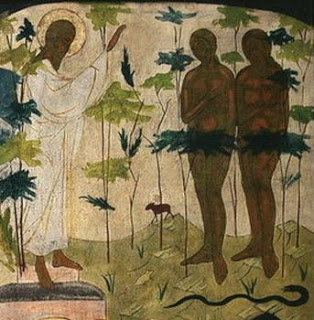
1930s-fresco-parisOrthodox Christianity has always proclaimed that humanity has essential value and professed that gender is quintessential to humanity. Humanity and gender are elemental qualities of being and are not dictated by external conditions. Outside conditions may warp one’s understanding and use of gender (and other things) but it can never fundamentally alter the essential reality. Besides the very obvious and glaring biological and physical realities of gender, Christianity teaches that gender, male and female, was established and created by God Himself in the very beginning,“From the beginning [He] made them male and female.” It is not an outside condition but an essential and intrinsic reality of existence for humanity. Indeed, human nature is expressed in male and female. Both share the common nature of humanity and thus are equal (note: not egalitarian) in essence but vary according to their definitive expression in gender. Female is not male, and male is not female. One is not superior to the other. Each bears a unique expression, distinct from the other, within the greater common nature of humanity. Here is God’s created diversity.

Inevitably my modern secular friends will be grinding their teeth. For them, gender has no part in a person’s role or expression in society, life, family, and so forth. They have labored hard to construct an androgynous society, faithfully hammering out Marxist ideology. At this point, the extremes are cast in ones face: “you think women should sit at home knitting! You think women should not vote! You’re a male chauvinist!” Just wait, calm down, and keep reading.

True Christianity defends that which is truly feminine and masculine. It confirms the uniqueness of each gender, a uniqueness that modernity is attempting to deconstruct and destroy. Women have been told that they must do everything a man does, effectively making man the standard of woman. Not much of a victory for women. Christianity, rather, encourages a woman to live according to her God-given gender, to grow in its unique attributes; likewise, it encourages a man.

Gender itself is an icon, an image. In the beginning, God made mankind in His image and likeness. Gender itself bears a participation in this image. According to revelation, male participates in the icon of Christ and female participates in the icon of the Church. St. Paul elaborates this theology in Ephesians 5:22 and following. There he expounds upon the relationship of a husband and wife. Ultimately he tells us that marriage itself is an icon of the mysterious relationship of God with His Church, “This mystery is profound, and I am saying that it refers to Christ and the Church” (Eph. 5: 32).

St. Clement further says, “Now I do not suppose that you are ignorant of the fact that the living church is the body of Christ, for the Scripture says, ‘God created them male and female.’ The male is Christ; the female is the Church … For the flesh is a copy of the Spirit. No one, therefore, who corrupts the copy will share in the original” (2ndClement). The deepest spiritual mysteries and principles are interwoven into creation by God Himself, gender not excluded. Gender itself and the proper interaction of male and female most of all in the divinely instituted state of marriage is a reflection of God with His most beloved creation. Gender has vast and deep significance. This is one of the reasons that moderns are seeking to deconstruct gender.

St. Symeon the New Theologian teaches, “This mystery is great – and beyond great! – and so it will always be, because the same sort of communion, and union, and intimacy, and kinship, which the woman has with the man and the man with the woman, such – understood in a manner adequate to God and as transcending our reason – it the relation which the Master and Maker of all has with the Church, as with a single Woman: blamelessly, ineffably, inseparably, and indivisibly united to her, being and living with her as with the one whom He loves and holds dear” (On the Mystical Life: The Ethical Discourses).

St. Symeon is clear, such things must be understood in a manner proper to God. Clearly, gender is of the created order. God is the only uncreated and eternal One. Although it is evident that Christ Jesus was incarnate as a male, thus holding true to the image of gender that He had created. Gender is a physical image created by Him to convey eternal spiritual principles. In our time gender has also been tragically reduced to sexual function, but in the Gospel view gender is so much more. Proper sexual function is but one of the aspects of gender. Thus, we must never sexualize the imagery that God has established. This is difficult for modern people. The base sexualization of gender has resulted in all sorts of problems, the objectifying of women, an epidemic of porn addiction, the horrendous growth of sex trafficking, all sorts of sexual perversions and misuses, to list but some. The attempted abolition of true gender identity, male and female, through the application of Marx’s nihilistic principles (or lack thereof) is responsible for the excessive sexual violence of our times.

True Christianity empowers persons to live in and strive towards the full beauty and potential of their God-given and created gender, which is unique. It acknowledges that womanhood bears its own special quality as does manhood. It never tells a man to act like a woman or a woman to act like a man. The nihilistic gender experimentation of modern secularism is nothing short of abusive. It is an ideology and nothing more, one that is being implemented forcefully without any thought of the long-term effects on society and humanity. Its message is clear: humanity is nothing, gender is nothing, you are nothing, so nothing really matters. Oh, and yes “sexual revolution” and experimentation is a fundamental goal of secular Marxist ideology. ( For more on this see – http://thefreedomsproject.com/from-russia-with-love/ )

True Christianity proclaims that every person is created with purpose, even down to their very clear biological gender. Humanity is indued with substantial divine meaning. Living within our God-given image and purpose is what the true Christian life is about. Only within God can humanity reach its ultimate meaning and reality.


Friday, October 27, 2017

The Rebellion of Korah


Originally posted on -   https://inklesspen.blog/2017/10/24/the-rebellion-of-korah/


True Christianity is priestly by nature, even more so, it has always had a defined priesthood. To deny priesthood is to deny an elemental component of Christianity.

“Wait,” the reply comes from certain groups, “we are all priests unto God, have you not read in the Scriptures, 'You yourselves are being built up as a spiritual house, to be a holy priesthood, to offer spiritual sacrifices acceptable to God through Christ Jesus … You are a chosen race, a royal priesthood, a holy nation, a people for His own possession' (1 Pet. 2: 5, 9). There is no longer,” they might say, “any official priesthood. It is now the priesthood of all believers.”

St. Peter is clearly referencing the Old Testament where the Lord God tells the Hebrews, “If you will indeed obey My voice and keep My covenant, you shall be my treasured possession among all peoples, for all the earth is Mine; and you shall be to Me a kingdom of priests and a holy nation” (Ex. 19:5). In the Old Testament, the Lord called the whole Hebrew nation priestly, while at the same time He established and set apart a specific priestly order according to the line of Aaron. Although the whole nation shared in a priestly anointing, only those selected by the Lord were empowered to serve in the fullness of priestly function at the altar of the tabernacle.

“But, that is the Old Testament!” Our friends might object. “Christ Jesus did away with the Old Testament priesthood!” Okay, let's examine this.

In the epistle of St. Jude, he warns Christians of three evils, heresies, “These people blaspheme all that they do not understand, and they are destroyed by all that they, like unreasoning animals, understand instinctively. Woe to them! For they walk in the way of Cain and abandoned themselves for the sake of gain to Balaam's error and perished in Korah's rebellion” (10-11). St. Jude makes reference to three Old Testament events, which depict spirits of error that even attempted to assert themselves in the early Church (and continue to this day). One may easily reference the Old Testament for a description of these errors. For the topic at hand, the last error, Korah's rebellion, is pertinent.

The error of Korah is covered in Numbers chapter 16. “Now Korah … and Dathan and Abiram … rose up before Moses, with a number of the people of Israel … they assembled themselves together against Moses and against Aaron and said, 'You have gone too far! For all the congregation are holy, every one of them, and the Lord is among them. Why then do you exalt yourselves above the assembly of the Lord'” (1-3)? Notice that they are partially correct. The Lord had said in Exodus that the whole nation is priestly and holy. Their error is that they fail to acknowledge the office of the priesthood as instituted by the Lord, in fact, they aggressively and willingly debase it. They apply to themselves something that does not belong to them: the ritual office of the priesthood. Their argument is the same as many Protestant groups today. Let's keep digging.

Moses, by command of the Lord, instructs Korah and company to come before the Tabernacle with incense, together with Aaron and the God-ordained priests (cf. vv. 4-19). “The Lord will show who is His” (vs. 5). When all were assembled, Moses said to the congregation of Israel, “'Depart, please, from the tents of these wicked men, and touch nothing of theirs, lest you be swept away with all their sins.' So they got away from the dwelling of Korah … as soon as he had finished speaking these words, the ground split apart. The earth opened its mouth and swallowed them up … all who belonged to Korah … and went down alive into Sheol, and the earth closed over them, and they perished from the midst of the assembly … to be a reminder to the people of Israel, so that no outsider, who is not of the descendant of Aaron should draw near to burn incense before the Lord, lest he become like Korah and his company” (vv. 25, 31-33, 40).

In short, the rebellion of Korah is the rejection of an official God-ordained priesthood. We are warned of it in the Old and New Testaments. The fruit of Korah's rebellion is frightening, he and all those with him perish. The description of St. Jude regarding those who embrace the spirit of Korah's rebellion is equally frightening, “Hidden reefs … waterless clouds, swept along by winds, fruitless trees … twice dead, uprooted … for whom the gloom of darkness has been reserved forever” (12-13).

In the New Testament Christ is the new High Priest. In His person the perfection of the priesthood took place. The Aaronic priesthood was but a foreshadowing of the true and ultimate priesthood of Christ Jesus. The Scriptures testify that Christ the Lord is a priest forever (cf. Heb. 7:17, 21). He, “holds His priesthood permanently, because He continues forever” (Heb. 7:24). He is clearly depicted fulfilling priestly functions in the heavens, He is a “liturgist in the holy places” (Heb. 2:8). The Christian Church has always understood Christ the Lord to be the fount, the foundation, and the source of the New Testament priesthood. St. John of Kronstadt sums the teaching up, “Christ is the only Chief Priest, the First and the Last … He Himself performs the duties of a priest in us and through us [priests] … My priesthood and that of all others is Christ's priesthood: the true, most high priest is Christ alone; He Himself ministers through us, He is the eternal priest according to the order of Melchizedek.” The priest participates by grace in the very Priesthood of Christ Himself. The person of the priest is an icon of Christ. He participates in the heavenly ministry of Christ the Lord, making it present in a tangible manner on earth through the One Body, the Church of Living God.

In the epistles to Timothy and Titus, the word Presbyteros is used. In Titus 1:5, St. Paul tells Titus (a Bishop) that he was left in Crete to “ordain presbyters/priests.” In most English translation presbyteros is translated as “elder” which is only a small portion of the meaning. Christianity has from the earliest times used the word to generally delineate priests. In Acts, it commonly says “the apostles and the priests (presbyters)” (cf. Act. 15:23; 16:4). The Apostles were endued with the authority to ordain priests. It is no longer according to bloodline but apostolic authority from Christ the Lord. St. Paul makes reference to Christian altars when he says, “We have an altar from which those who serve the tabernacle have no right to eat” (Heb. 13:10). An altar is always connected to priestly service.

St. Ignatius of Antioch, historically proven to be a faithful disciple of St. John the Apostle, says, “Let everyone respect the deacons as Jesus Christ, just as they should respect the bishop, who is the model of the Father, and the presbyters as God's council and the band of the apostles. Without these, no group can be called a church.” The saint is clear, there can be no true Church without priesthood. The Christian witness from St. Ignatius on clearly confirms a Christian priesthood.

St. Paul in Romans makes an incredible priestly statement, which most of the time in English is not translated properly, “Grace was given to me by God, in order for me to be a liturgist (minister) of Jesus Christ to the nations, ministering as a priest (in Greek, hierourgeo) in sacred sacrifice the Gospel of God, that the offering (prosphora) of the nations might be acceptable, sanctified in the HolySpirit” (15:16). The Greek word hierourgeo comes from hiero – pertaining strictly to the ritual function of the priest, serving the altar, offering sacrifice, and so forth – and ergon – work, action, etc. The word is undeniably priestly. St. Paul is making a clear reference to his actual ministry as a priest, traveling the nations and offering the Christian Liturgy. Anyone continuing in True Christian worship of Liturgy understands the deep references made by St. Paul. St. John Chrysostom confirms that St. Paul is speaking specifically of his priestly ministry, “He is not speaking simply of service, as in the beginning [of Romans], but of liturgy and celebrating the sacrifice [holy communion].”

In both Old and New Testaments there have existed the general priestly function of the people of God and the very distinct ordained priesthood which serves the altar of the Living God. When priests fail in their vocation before God they are rebuked severely and bear a greater punishment than the people of God. Because of weakness men who are priest do not always live in a manner worthy of their office, but this never negates the reality of priesthood. The essential point is that true worship of the Living God employs priesthood. This is undeniable.


There is no priest-less Christianity, Church, as St. Ignatius makes clear. There are those who deny priesthood, together with Korah, but the Scriptures have spoken clearly on the fruit of such a denial. 


Tuesday, October 3, 2017

Orthodoxy: Tradition Not of This World

By Constantine Cavarnos


"Orthodox always regarded the unchanging persistence of the Orthodox Church in Sacred Tradition as her boast. On the contrary, the heterodox — with exceptions, especially in recent times — regarded this persistence as a sign of decline, as a sign of deficiency in her inner life. In particular, the Protestants hurled the reproof that the Orthodox Church is 'dead' and likened her to a 'petrified mummy.' This demonstrates the ignorance which the heterodox customarily have about the true essence of Christianity, and shows to what degree they confuse the revealed faith with the different worldly systems, with the different human contrivances and creations. Since in the crafts and the sciences there is a continuous development and perfection, they think that the same thing ought to happen in the Christian religion, that here too there should be a continuous revision, change, and replacement of the old by the new—in a word, 'modernization.' Looking at Christianity rationalistically, they misunderstand its revelatory character and demote it to the level of the systems which the mind of man has formed on the basis of reason and the observations of the five senses.

If strict perseverance in Tradition does not entail the deadening of the Church, but on the contrary is absolutely necessary for the preservation and fruitfulness of the life of the Church, as much again the disregard for and even partial abandonment of Tradition entails the slackening of her life and her gradual decomposition. The most persuasive witness to this is borne by the history of the Western Church, which introduced one novelty and "modernization" after the other, chiefly from the time of the Schism and after. This Schism of the Western Church from the Eastern Orthodox Church was a result of Western innovations. And the very revolution of the Protestants, which split the Western Church into warring parties, was a result of the downfall of the Western Church, a downfall which occurred as a consequence of her distortion of Sacred Tradition.

Nevertheless, the introduction of innovations continued. At the end of the nineteenth century, for example, there appeared in the bosom of the Roman Catholic Church the movement of "Modernism" or Modernization, which set as its goal the renovation of Christian teaching by adapting it to contemporary worldly thought. The representatives of this movement inflicted one damage after another on Christian doctrine, and thought that in this way they would revivify their Church. But the result of this spurious Christianity of discarding truths of the Faith and making 'adaptations' was that large numbers of persons left the churches and became complete unbelievers (cf. P. Melitis, Let the Way be Cleared [Athens, 1957], p. 28).


Protestantism, having denied the unwritten Tradition, was quickly divided into different confessions, and they again into others, and so on, so that there exist today countless Protestant confessional groups ... a result of the different innovations and adaptations to each 'contemporary spirit.'"


Saturday, August 12, 2017

A True Heart

By St. John of Kronstadt


The Christian has no reason to have in his heart any ill-feeling whatever against anyone - such ill-feeling, like every evil, is the work of the devil; the Christian must only have love in his heart; and as love cannot think of evil, he cannot have any ill-feeling against others ... We must not let evil in any form nestle in our heart; but evil generally appears in too many forms.

When on your way to God you meet obstacles raised up by the devil: doubt and unbelief of heart, also a thorough ill-feeling, sometimes towards persons worthy of absolute respect and love, as well as other passions. Do not be disturbed by them, but know it is but the smoke of the enemy, which will be dispersed at a sign from our Lord Jesus Christ.

Saturday, July 1, 2017

The Last Judgment, by St. John Maximovich

St. John Maximovich

The Day Of the Last Judgment! That day no one knows -- only God the Father knows -- but its signs are given in the Gospel and in the Apocalypse of the holy Apostle John the Theologian. Revelation speaks of the events at the end of the world and of the Last Judgment primarily in images and in a veiled manner. However, the Holy Fathers have explained these images, and there is an authentic Church tradition that speaks clearly concerning the signs of the approach of the end, and concerning the Last Judgment. Before the end of life on earth there will be agitation, wars, civil war, hunger, earthquakes... Men will suffer from fear, will die from expectation of calamity. There will be no life, no joy of life but a tormented state of falling away from life. Nevertheless there will be a falling away not only from life, but from faith also, and "when the Son of Man cometh, shall He find faith on the earth?" (St. Luke 18:8). Men will become proud, ungrateful, rejecting Divine law. Together with the falling away from life will be a weakening of moral life. There will be an exhaustion of good and an increase of evil. 

Of these times, the holy Apostle John the Theologian speaks in his God-inspired work, the Apocalypse. He says that he "was in the Spirit" when he wrote it; this means that the Holy Spirit Himself was in him, when under the form of various images, the fate of the Church and the world was opened to him, and so this is a Divine Revelation. 

The Apocalypse represents the fate of the Church in the image of a woman who hides herself in the wilderness: she does not show herself in public life, as today in Russia. In public life, forces that prepare the possibility for the appearance of Antichrist will play the leading role. 

Antichrist will be a man, and not the devil incarnate. "Anti" means "old," and it also signifies "in place of" or "against." Antichrist is a man who desires to be in place of Christ, to occupy His place and possess what Christ should possess. He desires to possess the attraction of Christ and authority over the whole world. Moreover, Antichrist will receive that authority before his destruction and the destruction of the world. 

What is known of this man -- Antichrist? His precise ancestry is unknown: his father is completely unknown, and his mother a foul pretended virgin. He will be a Jew of the tribe of Dan. He will be very intelligent and endowed with skill in handling people. He will be fascinating and kind. The philosopher Vladimir Soloviev worked a long time at presenting the advent and person of Antichrist. He carefully made use of all material on this question, not only Patristic, but also Moslem, and he worked out a brilliant picture. 

Before the advent of Antichrist, there was a preparation in the world, the possibility of his appearance. The mystery of iniquity doth already work (II Thes. 2:7). The forces preparing for his appearance fight above all against the lawful Imperial authority. The holy Apostle Paul says that Antichrist cannot be manifested until what withholdest is taken away (II Thes. 2:6-7). St. John Chrysostom explains that the "withholding one" is the lawful pious authority: such an authority fights with evil. For this reason the "mystery," already at work in the world, fights with this authority; it desires a lawless authority. When the "mystery" decisively achieves that authority, nothing will hinder the appearance of Antichrist any longer. 

Fascinating, intelligent, kind, he will be merciful — he will act with mercy and goodness; but not for the sake of mercy and goodness, but for the strengthening of his own authority. When he will have strengthened it to the point where the whole world acknowledges him, then he will reveal his face. 

For his capital, he will choose Jerusalem, because it was here that the Savior revealed His Divine teaching and His person. It was here that the entire world was called to the blessedness of goodness and salvation. The world did not acknowledge Christ and crucified Him in Jerusalem; whereas, the whole world will acknowledge the Antichrist’s authority and Jerusalem will become the capital of the world. 

Having attained the pinnacle of authority, Antichrist will demand the acknowledgement that he has attained what no earthly power had ever attained or could attain and then demand the worship of himself as a higher being, as a god. 

V. Soloviev describes the character of his activity well, as "Supreme Ruler." He will do what is pleasing to all -- on the condition of being recognized as Supreme Authority. He will allow the Church to exist, permit her Divine services, promise to build magnificent churches…. on the condition, that all recognize him as "Supreme Being" and worship him. Antichrist will have a personal hatred for Christ; he will see Him as a rival and look upon Him as a personal enemy. He will live by this hatred and rejoice in men's apostasy from Christ. 

Under Antichrist, there will be an immense falling away from the faith. Many bishops will change in faith and in justification will point to the brilliant situation of the Church. The search for compromise will be the characteristic disposition of men. Straight-forwardness of confession will disappear. Men will cleverly justify their fall, and gracious evil will support such a general disposition. There will be the habit of apostasy from truth and the sweetness of compromise and sin in men. 

Antichrist will allow men everything, as long as they "fall down and worship him"; and the whole world will submit to him. Then there will appear the two righteous men, who will fearlessly preach the faith and accuse Antichrist. According to Church tradition, they are the two Prophets of the Old Testament, Elijah and Enoch, who did not taste of death, but will taste it now for three days, and in three days they must rise. Their death will call forth the great rejoicing of Antichrist and his servants. Their resurrection will plunge them into great confusion and terror. Then, the end of the world will come. 

The Apostle Peter said that the first world was made out of water — an image of the primordial chaos, and perished by water — in the Flood. Now the world is reserved unto fire. The earth and the works that are therein shall be burned up (II Peter 3:5-7, 10). All the elements will ignite. This present world will perish in a single instant. In an instant all will be changed. 

Moreover, the Sign of the Son of God, the Sign of the Cross, will appear. The whole world, having willingly submitted to Antichrist, will weep. Everything is finished forever: Antichrist killed, the end of his kingdom of warfare with Christ, the end, and one is held accountable; one must answer to the true God. 

"The end of the world" signifies not the annihilation of the world, but its transformation. Everything will be transformed suddenly, in the twinkling of an eye. The dead will rise in new bodies: their own, but renewed, just as the Savior rose in His own body and traces of wounds from the nails and spear were on it, yet it possessed new faculties, and in this sense it was a new body. It is not clear whether this new body will be the same as Adam was made, or whether it will be an entirely new body. 

Afterward, the Lord will appear in glory on the clouds. Trumpets will sound, loud, with power! They will sound in the soul and conscience! All will become clear to the human conscience. The Prophet Daniel, speaking of the Last Judgement, relates how the Ancient of Days, the Judge sits on His throne, and before Him is a fiery stream (Daniel 7:9-10). Fire is a purifying element; it burns sin. Woe to a man if sin has become a part of his nature: then the fire will burn the man, himself. 

This fire will be kindled within man: seeing the Cross, some will rejoice, but others will fall into confusion, terror and despair. Thus, men will be divided instantly. The very state of a man's soul casts him to one side or the other, to right or to left.

The more consciously and persistently man strives toward God in his life, the greater will be his joy when he hears: "Come unto Me, ye blessed." Conversely: the same words will call the fire of horror and torture to those who did not desire Him, who fled and fought or blasphemed Him during their lifetime! 

The Last Judgment knows of no witnesses or written protocols! Everything is inscribed in the souls of men and these records, these "books," are opened at the Judgment. Everything becomes clear to all and to oneself. 

Moreover, some will go to joy, while others — to horror. 

When "the books are opened," it will become clear that the roots of all vices lie in the human soul. Here is a drunkard or a lecher: when the body has died, some may think that sin is dead too. No! There was an inclination to sin in the soul, and that sin was sweet to the soul, and if the soul has not repented and has not freed itself of the sin, it will come to the Last Judgment with the same desire for sin. It will never satisfy that desire and in that soul there will be the suffering of hatred. It will accuse everyone and everything in its tortured condition; it will hate everyone and everything. "There will be gnashing of teeth" of powerless malice and the unquenchable fire of hatred. 

A "fiery gehenna" — such is the inner fire. "There will be wailing and gnashing of teeth." Such is the state of hell.


Originally published in the Orthodox Word, 1966, Vol. 2, No 5 (11). Nov - Dec. 


Wednesday, May 24, 2017

Techno Buddy Jesus and Orthodism.

It is, at times, costly to be an Orthodox Christian.

Christ the Lord calls His followers to humble repentance. The Faith instructs us to seek Christ Jesus, and Him alone. Don't expect to be a superstar. Don't even seek the gifts that He can give. Love only Him, desire only Him. All things pass, only Love remains. But just around the corner, one can learn to be an “anointed one,” or give improv “words” from God over a cup of coffee. I discern in these coffee grounds …. So convenient, and “I” feel special too.

Orthodoxy is not cool. We are guarded and guided by a very ancient Christian way of life. It calls us to simplicity, constancy, and steadfastness. But a few blocks away one can jump on all the latest bandwagons of religious and philosophical fluidity. Smoke machines and disco lights (are they even still hip?) and rock music (or whatever floats your boat). “God is good” on a repetitive loop multiplied times one hundred. No need to think too deeply because God is not into doctrine and all that stuff. Feel the beat. Easy power and shallow pools, everything can be quite well known and comfortable.

The Church Fathers; saints? Aren’t they just quaint old folk of yesteryear? Charming grandfathers who speak of times past. How cute. I mean, they do add a hue of credibility and stateliness. But we need the vigor of the modern! Psychology will save us! After all the Father's did not live in our times, they don't really understand the problems facing us. Let's sit around and talk about how we feel; then we'll turn and give our neighbor a massage. Hip Jesus can be the group facilitator! He is so relevant and unoffensive. Fall backward into a quilted mass of comforting arms. Do you feel safe now, is this a safe place? Warm and fuzzy. I'm so special. God loves me just the way I am. Do you accept me, am I accepted? Orthodism: just want to be one of the guys; it is neither hot nor cold, and it will never be as sensational as the pulsating mass of mutability that it seeks as its guru. Teach us. We also desire to be hipsters. We are important too … do you approve?

Orthodoxy calls us out of the self-approved masses into the depths of God, where our human intellect fails. My feet cannot touch the bottom. How deep is it? What is down there, in the depths? Where does it end? No one knows. As far as the eye can see, there is no land. What if I drown? I am helpless. Who will know that I have sunk down into the depths? I am in such great need of God. Our humanity recoils in fear. All earthly safety has fled away. Our self is shuttering at the revelation of its own decrepitude. It will die in the depths. Only death bears resurrection.

No! Give me the comfort of the kiddie pool where I can get wet, touch the bottom, and be the master of my own domain. Here, so many choose to dwell.

True Christianity calls us to take up the cross and follow Christ, to lose our life and thereby save it.  The way of the True Christ is the way of the cross. Modernity instructs us to exploit Christ as a means of self-aggrandizement. The gospel of Me says, seek self-fulfillment, seek spiritual power, seek to be recognized as special, seek comfort, seek safety, be nice. Contemporary Jesus has come to save the self, twisting, flashing, mesmerizing, and fluttering like an enormous multicolored neon sign. So shiny. Did Buddy Jesus just wink at me from his technicolor aura? What is that catchy tune he is humming? Follow me, I'm all-powerful, and you can be too! Repentance, what the heck is that? I'll empower you in twenty seconds flat … Feel the beat. How grand it seems!

How drab the humble cross, only dull brown wood after all. Will I get a splinter? It's not even electrified, and with no wifi!?

We may muse with a character from Fahrenheit 451, “I often wonder if God recognizes His own son the way we've dressed him up, or is it dressed him down? He's a regular peppermint stick now, all sugar-crystal and saccharine when he isn't making veiled references to certain commercial products that every worshiper absolutely needs.” Ah, the magic sugar daddy in the heavens, who's one job it is to cater to my every desire!


As a lamb to the slaughter despised and rejected, so went our Lord and so must we. Leave the glimmer of show-time christs. Come, follow Me, says the Lord, take up your cross, which is foolishness to this world and its christs. It will cost you your self. Be of good cheer, for I have overcome the world.  

Tuesday, April 18, 2017

Living the Faith

By St. Philaret of Moscow.

Ah, friends, without faith in the Lord Christ there is no salvation!
We must by all means kindle in ourselves the spirit of faith, that is, stimulate it, feed it with prayer, the Word of God, patience, sincere remembrance of the Savior Who suffered for us. All of this can be done every day.

What to Do in the Morning

When you wake up, first of all let your soul and heart say "Glory to Thee, O Lord, Who has preserved us this night! Glory to Thee, Who has shown us the light! Lord, bless this day for us!" In doing this, think about how God gives you the day which you could not give to yourself, and devote the first hour, or perhaps the first quarter hour of the day given you and offer it as a sacrifice to God, in grateful, supplicatory prayer. The more zealously you do this, the more you will sanctify your day, the more strongly you will protect yourself from the temptations that we meet every day.

The Dwelling and Clothing of the Christian

From the start of the morning and throughout the day, make the thought about Christ the soul of your life, the moving force of your actions. So, for example, if you glance over your dwelling, remember Christ in the manger, in swaddling clothes, lying on straw, all this life not having a place to lay His head, finally imprisoned, nailed to the Cross, and thank God for your house, your shelter, however humble and poor it may be. Do not envy magnificently decorated mansions: the mansion of Christ is a pure heart!

As you dress in your simple clothing, remember Christ stripped naked and then robed in the clothing of mockery. Do not dwell on apparel, do not follow slavishly the whims of fashion, but try to garb yourself in goodness, humility, meekness, long-suffering, gazing mentally on the meek and humble heart of Jesus.

If you are eating a meal, remember the vinegar and gall that Christ tasted, and do not demand plentiful, luxurious food and drink: the heavenly Guest loves to enter not the house of feasting, but always to the one that opens the door of his heart to Him. Place in your heart Christ suffering and dying on the Cross, and in His unseen presence mortify your passions and lusts.

Contact with people

Later, when you deal with people, both relatives and others, before saying a word, think about what will be its effect, and think even more seriously before you do something in their presence, for actions speak louder than words.

Worldly Affairs

If you are undertaking anything, before asking any other adviser, ask the advice of faith. Appeal in the words of the Apostle: Lord, what wilt Thou have me do? (Acts 9:6). Is what I would undertake pleasing to Thee, Lord? If it is pleasing, bless it; if not, do not let me do what is displeasing to Thee. And then listen to what the Lord tells you in your conscience, in your reason, in the counsels of pious and wise people and, having begu n the course that you select, pray in your heart, O Lord, make haste to help me (Ps. 69:1).
Absences

If you are going anywhere, go with God, as our pious forebearer said as a farewell, walk before me as the Lord Himself demanded (Gen. 17:1); always see Him before you, for He is at thy right hand (Ps. 15:8). As much as possible keep in your thoughts and in your heart that God sees you, so that you may be both ashamed and afraid to attempt anything unworthy before the eyes of God.

Word and Feelings

If you enter the company of people, behave with extreme caution. If you hear a word of praise for yourself there, be careful: praises frequently conceal flattery and can arouse in you self-satisfaction and neglect of your further improvement. If you hear an insulting or humiliating word, take care not to become inflamed with anger which worketh not the righteousness of God (James 1:20). Answer the one who insults you either with silence or a meek word of truth. If you hear a word that accuses a neighbor, be careful that you not take part in the sin of someone else's tongue. Do not join in words that are more harmful to the one who judges than to the one being judged. If you hear a word that saddens one with bad news, be careful lest your sorrow become stronger than your common sense; dissolve it with hope in God's mercy and with the warm prayer: O my Rejoicing, deliver me from them which have encircled me (Ps. 31:7). Endure without complaint sorrows and misfortunes. Sorrows are inescapable on the path leading to the Kingdom of God! Many are the sorrows of the righteous! Christ Himself endured them; the Mother of God endured them as well. Without sorrows we will not be saved, but even in the depth of sorrow believe that the Lord loves you truly, and is only testing you. Remember: you sometimes return home from afar by a bad road, in a storm, in frost, or in terrible heat, but you go patiently, willingly; likewise patiently go by the difficult and sorrowful path to the heavenly home, the Kingdom of God.

Caution Regarding Harmful Books

If you see in a letter or a book a word of unbelief, irreverence, or indecency, turn your eyes away from it quickly, do not entice yourself with the thought of reading it out of curiosity or for amusement. Do not touch filth. Do not play with fire. Do not desire to experience the taste of poison.
In general, in your relations with people be peaceable, just, compassionate, do good even to your enemies, imitating Him Who shines His sun on both the evil and the good.
If you will live and act in this manner, then, when you pray, nothing will obstruct your prayer's path to heaven.

Attending Church

When the time comes, and especially the time put aside for God and His temple, a feast day or the hour of Divine Services, hurry to tear yourself away from business and worldly cares and voluntarily and zealously offer yourself to God in His church. When you enter the church bring to mind the promise of the Lord to those that gather in His name: there am I in the midst of them (Matt. 18:20), and stand reverently in church, as before the very face of Christ, and pray to Him that he sanctify you by His holiness, animate you by His prayer, and enlighten you with the word of the Gospel and the Grace of the Mysteries. Take note of this, too: in the church, angels serve with us and guard the holiness dwelling there. Once, in the Lavra of Saint Theodosius near Jerusalem, Abba Leontius, coming one Sunday to church to receive the Holy Mysteries, saw an angel standing on the right side of the Holy Table, and when the elder, being afraid, turned to run to his cell, the voice of the angel called to him: "From the time this Holy Table was consecrated, I have been charged to stay by it." Remember this, beloved, and stand reverently. And, if you feel that only your body is standing in church, while your mind thinks of home, or the market, or a place of merriment, collect yourself. Hurry to bring back your mind that has strayed, join it to God in your heart, force it to strive towards God, Who looks upon you. When you hear the word of God, open up not only your bodily ears, but your spiritual ones as well, open your heart, receive this heavenly Bread and with it nourish not only your memory, but also your life and work.

On Communion

When you are preparing to be a communicant of the Body and Blood of Christ, or are simply present at this Mystery, cleave in mind and heart to the Cross and the Tomb of the Lord, to the Body of Christ, suffering, dying, buried, risen, glorified and believe that your faith's touching Him will be more substantial than the touching of His garment by the woman with an issue of blood, and Christ's power [will] go out (Luke 8:46) to purify and elevate your powers of soul and body.

How to Celebrate Feast days

Having left church and returned home, do not rush to worldly business on days dedicated to God: business that you illicitly conduct in festal times will bring you no benefit. Realize most of all that if you do not come to thank and glorify God in His church, then you can be sure that He will not send down His blessing on your business outside the church (Haggai 1:9). And if sometimes you decide to excuse yourself from attending the church, be in fear lest you suddenly be overtaken by death and lest it be said of you: Remember that thou in thy lifetime received thy good things... but now (in eternity) thou art tormented (Luke 16:25). God preserve you from this fate.

Never forget that your soul is also God's temple, and if at any time an impure thought and evil desire draws near to your soul, and will draw your body as well towards sin, hasten to protect yourself with the words said to the first Christians, and consequently to you: Know ye not that ye are the temple of God, and that the Spirit of God dwelleth in you? (I Cor. 3:16). Then say to yourself: how can I dare to ruin the temple of God, by sin and inequity! How can I be so bold as to insult and alienate the Holy Spirit!

What to do in the evening

Now the day has ended - you are going off to sleep. Ponder the thought that God gives you rest from labors, and take the first fruits of the time of your rest and dedicate it to God with pure and humble prayer. Its fragrance will draw an angel close to preserve your rest. While preparing for sleep, remember death, of which sleep is an image and threshold, and with a prayer of faith surrender yourself to Him that is the Resurrection and the Life (John 11:25). But when you can conquer sleep, or when it does not conquer you, remember [the Lord's] name in the night (Ps. 118:55). Such should be the constant disposition and activity of the believer that he may gradually draw near to that state of soul in which the holy Apostle Paul says of himself: I live by the faith of the Son of God, Who loved me and gave Himself for me... Yet not I, but Christ liveth in me (Gal: 2:20)!


Translated by Seraphim F. Englehardt From "Orthodox Life" [in Russian], No. 10, 1952 

Thursday, March 9, 2017

Are We Truly Orthodox Christians?


by St. John of Kronstadt

So were rivers of blood shed for the preservation of the Orthodox Faith by apostles, prophets, and martyrs; much suffering was endured be reverend fathers and other champions of the faith.

What about us, children of the Orthodox Church? Do we preserve this most precious heritage, the Orthodox Faith? Do we follow its teachings, commandments, rules, statutes, advice? Do we love to offer this service to God, the fruit of our lips, giving thanks to His name (Heb. 13:15)? Are we renewed by it? Do we sanctify ourselves every day, do we correct ourselves, do we attain the perfection the saints attained? Do we perfect ourselves in our love for God and neighbor, do we cherish our faith, do we consider it the greatest mercy of God, the very first and greatest benefit of life the fact that we are fortunate to belong to the Orthodox Church, which is the One, Holy, Catholic and Apostolic Church?

What is our answer to these questions, if we desire to answer honestly? To our shame we must confess that many, many Orthodox Christians not only do not have the Orthodox faith in their hearts and lives, but also do not have it even in their tongues, and faith has either completely disappeared from their lives or they have become completely indifferent toward any faith: Catholicism, Lutheranism, Judaism, Islam, even paganism. We hear from many people that you can please God in every faith, that is, as if every faith is pleasing to God, and as if God is indifferent to truth and falsehood, right and wrong. Look at the consequences of ignoring one's faith, of the ignorance of the spirit and history of their Church, alienation from its life and divine services, the consequences of ignoring concepts of Orthodoxy, Heterodoxy, and other faiths!

A Christian as a member of the Church, must know his faith and try to live according to it, be saved by his faith, because the enemies of our salvation do not sleep, and seek our destruction at every hour; a Christian must not abandon his faith …

No other religion except Orthodoxy can bring man to moral perfection or holiness and perfect agreeableness to God, as evidenced by the history of the church and the incorrupt and wonderworking remains of the holy saints of God, and by the wonderful feats of the saints of the Orthodox Church … so it should be, according to common sense, only a perfect faith can bring one to perfection, with all divine powers, all the spiritual armor of God against the passions of the flesh, the world, and the devil.

If nowadays many Orthodox Christians live worse than Muslims and pagans … this truly impious life of the Christian must not in the least, of course, be blamed on the Orthodox Faith, which is unwavering in its principles of truth and holiness, according to the promise of the Savior Himself and the testimony of history. Such people, even though they came from us, were never one of us in essence, but only in name.

Yes, my brethren, only the Orthodox Faith purifies and sanctifies human nature stained by sin; it renews the corrupted, especially through the mysteries of baptism, repentance, and communion. It illumines those who are darkened and heals those who are wounded by sins … Would you like to be convinced of this? Read the lives of the saints, the history of the Church, and you will see firsthand all of these miracles in the lives of the saints.

Why does it not also effect such saving changes within us? Because of our lack of faith, or unbelief, because of our frivolity, corruption, and the impenitence in our hearts; because of the passions that grow stronger within us and have complete control over us, because of our falling away from the Church, and because many of us do not in the least instill within ourselves the spirit of the Church, and many others insincerely, weakly, and only slightly more formally belong to it.

For us to be true Orthodox Christians, we must first of all have a living, constant communion with the Orthodox Church; that is, we must partake in its prayers, teachings, and mysteries; we must diligently study our faith and be instilled with and live its spirit; we must be guided by its rules, commandments, statutes, and more important, we must restore within ourselves the image of true and deep repentance of a true Orthodox Christian according to the image of the saints, old and new, or better according to the image of our Lord Jesus Christ Himself, Who said: For I have given you an example, that you should do as I have done to you (Jn. 13:15), so that the Lord may say of us, as once he said of Nathaniel: Behold, an Israelite indeed, in whom there is no deceit (Jn. 1:47). Amen.


From: Season of Repentance, Lenten Homilies of St. John of Kronstadt, Holy Trinity Publications.
Sermon on the Sunday of Orthodoxy, p. 92ff.


Tuesday, August 30, 2016

A prayer for Orthodox Christians of the Latter Times

For Daily Use

By St. Anatole (the Younger) of Optina


"Deliver me, O Lord, from the deceptions of the God-hating and evil antichrist, whose coming is at hand, and shelter me from his snares in the secret desert of Thy salvation. Grant me, O Lord, strength and courage to firmly confess Thy Most Holy Name, that I may not abandon Thee because of the devil's fear and that I may not deny Thee my Saviour and Redeemer, nor Thy Holy Church. But grant me, O Lord, cries and tears for my sins, and spare me in the hour of Thy dread judgment.    Amen"


Saturday, July 30, 2016

Emblematically Traced ...

By, St. John of Kronstadt


"In the temple, in its arrangements and parts, in the icons, in the Divine services, with the reading of the Holy Scripture, the singing, the rites, the entire Old Testament, New Testament, and Church history, the whole Divine ordering of the salvation of mankind is emblematically traced, as upon a chart, in figures and in general outlines. Grand is the spectacle of the Divine services of our Orthodox Church for those who understand it, who penetrate into its essence, its spirit, its signification, its sense!"


From: My Life in Christ, Holy Trinity Publications, p. 394.


Friday, July 15, 2016

Everything is in the Hands of God

An incident from the life of the Tsar-Martyr Nicholas II.

St. John of Kronstadt
The Revolution of 1905-1906 was a warning to the Russians that, if they did not return to Christ as a nation, and if they continued to work and fight against their anointed ruler, they could lose God's blessing. As St. John of Kronstadt said in 1905: “Our Tsar is a man of righteous and pious life. God sent him a heavy cross of sufferings, as to His chosen one and beloved child, as is said by the seer of the mysteries of God's judgment: As many as I love, I rebuke and chasten (Rev. 3:19). If the Russian people do not have repentance, the end of the world will be near. God will take the pious Tsar from them and will send a scourge in the persons of impious, cruel, self-proclaimed rulers, who will inundated the whole land with blood and tears.” It is to the great credit of Tsar Nicholas that he was able to keep this from happening for more than ten years.

A great insight into Tsar Nicholas' character can be gained from the following incident, which occurred during one of the most violent moments of the aforementioned revolution. At the imperial residence at Peterhof, near the naval base of Kronstadt, which was under siege by insurrectionists, artillery shelling could be heard. Nicholas' foreign minister, Alexander Izvolsky, was giving a report to the Tsar at the time, and later recalled the following:

Tsar-Martyr Nicholas II
“He listened attentively, and, as was his habit, asked questions now and then, showing his interest in the smallest detail of my report. Glance as I would in his direction, I could not detect the slightest trace of emotion in his countenance, although he knew well that it was his crown that was at stake at that moment, only a few leagues away…. When my report was finished, the Emperor remained a few moments looking calmly out at the open window at the line of the horizon. For my part, I was oppressed by profound emotion, and could not refrain, even at the risk of infringing the rules of etiquette, from expressing my surprise at seeing him so unmoved. The Emperor did not apparently resent my observation, for he turned to me with a look which has so often been described as one of extraordinary gentleness, and replied in these few words, deeply engraved in my memory:

'If you see me calm, it is because I have the firm, the absolute conviction that the fate of Russia, my own fate, and that of my family is in the hands of God, Who has placed me where I am. Whatever happens, I will bow to His will, conscious of never having had a thought other than that of serving the country that He confided to me.'”


From: The Royal Passion-bearers of Russia, Their Life and Service. St. Herman Press, p. 13.


Wednesday, June 29, 2016

What Will You Choose?

A timeless message from the Archbishop Averky of Blessed Memory. May we have ears to hear and eyes to see.
Originally entitled "True Orthodoxy".


"Few people today know that the Orthodox Church is nothing less than that Church which has preserved untainted the genuine teachings of Jesus Christ, the very teachings delivered to every subsequent generation of believers. These teachings came down the centuries. from the Holy Apostles, explicated and carefully interpreted by their legitimate successors their disciples and the holy Fathers), traditioned and conserved unaltered by our Eastern Church which is alone able to prove her right to be called "the Orthodox Church."

The divine Founder of the Church, our Lord Jesus Christ, said clearly, "I will build my Church and the gates of Hell will not prevail against Her" (St. Matt 16: 18). To the Church, He sent the Holy Spirit. The Spirit descended upon the Apostles, the Spirit of Truth (St. John 15:16f) Who "manifests all things" to Her and guides Her (St. John xvi, 13), protecting Her from error. Indeed, it was to declare this Truth to men that the Lord came into the cosmos, according to His own words (St. John 18:31). And Saint Paul confirms this fact in his letter to his pupil, the bishop Timothy, saying that, "the Church of the living God is the ground and pillar of the Truth" (I Tim 3:15).

The Church of Christ, the Ark of Salvation.
Because She is "the ground and pillar of the Truth," "the gates of Hell cannot prevail against Her." It follows, then, that the true Christian Church—palpably unique since Christ established but one Church—has always existed on earth and will exist to the end of time. She has received the promise of Christ, "I will be with you even unto the end of the age." Can there be the slightest doubt that the Lord refers here to the Church? Any honest and sane judgment, any act of good conscience, anyone familiar with the history of the Christian Church, the pure and unaltered moral and theological teachings of the Christian religion, must confess that there was but one true Church founded by our Lord, Jesus Christ, and that She has preserved His Truth holy and unchanged. History reveals, moreover, a traceable link of grace from the holy Apostles to their successors and to the holy Fathers. In contrast to what others have done, the Orthodox Church has never introduced novelties into Her teachings in order to "keep up with the times", to be "progressive", "not to be left at the side of the road," or to accommodate current exigencies and fashions which are always suffused with evil. The Church never conforms to the world.

Indeed not, for the Lord has said to his disciples at the Last Supper, "You are not of this world." We must hold to these words if we are to remain faithful to true Christianity—the true Church of Christ has always been, is and will always be a stranger to this world. Separated from it, she is able to transmit the divine teachings of the Lord unchanged, because that separation has kept Her unchanged, that is, like the immutable God Himself. That which the learned call "conservativism" is a principal and, perhaps, most characteristic index of the true Church.

Since the TRUTH is given to us once and for all, our task is to assimilate rather than to discover it. We are commanded to confirm ourselves and others in the Truth and thereby bring everyone to the true Faith, Orthodoxy.

Unfortunately, there have appeared in the very bosom of the Church, even among the hierarchy, opinions expressed by well-known individuals which are detrimental to Her. The desire to "march with the times" makes them fear that they will not be recognized as "cultured", "liberal" and "progressive." These modern apostates to Orthodoxy are "ashamed" to confess that our Orthodox church is precisely the Church which was founded by our Lord Jesus Christ, the Church to which appertains the great promise that "the gates of Hell will not prevail against Her," and to which He confided the plenum of divine Truth. By their deceit and false humility, by their blasphemy against the Lord, these false shepherds and those with them have been estranged from the true Church. They have given tacit expression to the idea that "the gates of Hell" have "prevailed" against the Church. In other words, these apostates say that our holy Orthodox Church is equally "at fault" for the "division of the churches" and ought now to "repent" her sins and enter into union with other "Christian churches" by means of certain concessions to them, the result being a new, indivisible church of Christ.

This is the ideology of the religious movement which has become so fashionable in our times: "The ecumenical movement" among whose number one may count Orthodox, even our clergy. For a long time, we have heard that they belong to this movement in order "to witness to the peoples of other confessions the truth of holy Orthodoxy," but it is difficult for us to believe that this statement is anything more than "throwing powder in our eyes." Their frequent theological declarations in the international press can lead us to no other conclusion than that they are traitors to the holy Truth.

As a matter of historical fact, the "ecumenical movement"—of which the WCC is the supreme organ—is an organization of purely Protestant origin. Nearly all the Orthodox Churches have joined, the Russian Orthodox Church Outside of Russia being the most notable exception.

We must understand the situation in terms of the words that "this Must take place" (St. Luke 11:9), that is, the "great apostasy" clearly predicted by the Lord (Sol 2:3-12). "it is permitted by God," as St. Ignatius Brianchaninov said almost a century ago. (Another spiritual father, Theophan the Recluse, announced with grief that the horrendous apostasy would begin within Russia.) St. Ignatius wrote: "We are helpless to arrest this apostasy. Impotent hands will have no power against it and nothing more will be required than the attempt to withhold it. The spirit of the age will reveal the apostasy. Study it, if you wish to avoid it, if you wish to escape this age and the temptation of its spirits. One can suppose, too, that the institution of the Church which has been tottering for so long will fall terribly and suddenly. Indeed, no one is able to stop or prevent it. The present means to sustain the institutional Church are borrowed from the elements of the world, things inimical to the Church, and the consequence will be only to accelerate its fall. Nevertheless, the Lord protects the elect and their limited number will be filled."

The Enemy of humanity makes every effort and uses all means to confound it. Aid comes to him through the total co-operation of all the secret and invisible heterodox, especially those priests and bishops who betray their high calling and oath, the true faith and the true Church.

Repudiation of and preservation from the apostasy which has made such enormous progress demands that we stand apart from the spirit of the age (which bears the seeds of its own destruction). If we expect to withstand the world, it is first necessary to understand it and keep sensitively in mind that in this present age all that which carries the most holy and dear name of Orthodoxy is not in fact Orthodox. Rather, it is often "A fraudulent and usurped Orthodoxy" which we must fear and eschew as if it were fire. Unlike this spurious faith, true Orthodoxy was given and must be received without novelty and nothing must be accepted as a teaching or practice of the Church which is contrary to the Holy Scriptures and the dogma of the Universal Church. True Orthodoxy thinks only to serve God and to save souls and is not preoccupied with the secular and ephemeral welfare of men. True Orthodoxy is spiritual and not physical or psychological or earthly. In order to protect ourselves from "the spirit of the age" and preserve our fidelity to the true Orthodoxy, we ought firstly and with all our strength live blamelessly: A total and rigorous commitment to Christ, without deviation from the commandments of God or the laws of His holy Church ... We must be honorable and tenacious, following the right way, never deviating in order to please men or from fear that we might lose some personal advantage.

The sure path to perdition is indifference and the lack of principles which is euphemistically called "the larger view." In opposition to this "larger view" we put the "rigor of ideas" which, in modernity, it is fashionable to label "narrow" and "fanatical." To be sure, if one adopts the "modern mentality," one must consider the holy martyrs—whose blood is "the cement of the Church"—and the Church Fathers—who struggled all their lives against heretics—as nothing less than "narrow" and "fanatical." In truth, there is little difference between "the broad way" against which the Lord warned and the modern "larger view." He condemned the "broad way" as the way to "gehenna."

Of course, the idea of "gehenna" holds no fear for those "liberals" and avant-garde theologians. They may smugly "theologize" about it, but in rashly and wantonly discussing "the new ways of Orthodox theology" and acquiring a number of disciples, they give evidence that they no longer believe in the existence of Hell. This new breed of "Orthodox" are really no more than modem "scholastics."

In other words, the way of these "progressivists" is not our way. Their way is deceptive, and it is unfortunate that it is not evident to everyone. The "broader" or "larger view" alienates us from the Lord and His true Church. It is the road away from Orthodoxy. This view is sinister, maliciously invented by the Devil in order to deny us salvation. For us, however, we accept no innovations, but choose the ancient, proven way, the way in which true Christians have chosen to serve God for 2,000 years.

We choose the way of fidelity to the true Faith and not the "modern way." We choose faithfulness to the true Church with all Her canons and dogmas which have been received and confirmed by the local and universal Councils. We choose the holy customs and traditions, the spiritual riches of that faith transmitted complete and entire to us from the Holy Apostles, the Holy Fathers of the Church, and the Christian heritage of our venerable ancestors. This alone is the faith of the true Orthodox, distinct from the counterfeit "orthodoxy" invented by the Adversary. We receive only the Apostolic Faith, the Faith of the Fathers, the Orthodox Faith."


Originally published in: The Orthodox Christian Witness, wherein it appeared translated from the French in La Foi Transmise (Nov. 1968), pp. 19-22.